
Name-Based Case Searches
Begin with the Perry County public search form. The main box takes a Party Name or an older Case Reference. Type full first and last names rather than fragments. Complete names cut down on noise. Even so, every match still needs a check of identity and case year. Common names pull in records that have nothing to do with your case. Before trusting a row, compare the court. Also check the case type, the original year, and the full number.
- Enter the full party name and select Circuit or General Sessions.
- Choose Criminal or Civil and add the original filing year when known.
- Keep Match all selected for a narrow first query and complete Turnstile verification.
- Review the returned cases and sort visible columns where available.
| Field Label | Type | Required | Notes |
|---|---|---|---|
| Party Name / Case Reference | Text | Search basis | Only the first ten words are considered. |
| Case Year | Four-character text | No | Use the original filing year. |
| Case Number | Text | No | Use the numeric part after the final hyphen. |
| Court and Case Type | Checkboxes | Yes | Circuit or General Sessions; Criminal or Civil. |
Perry County Portal Verification
The public form runs a Turnstile check before Find Now will work. Subscription Login is a separate thing. The public page says nothing about its price or what extra content it holds. Anyone can read the fields and help text without paying. The form offers no public date-range, attorney, judge, disposition, status, document-type, or export control. The portal landing screen lays out the county route. That official page helps you spot the correct service before you start a docket search.
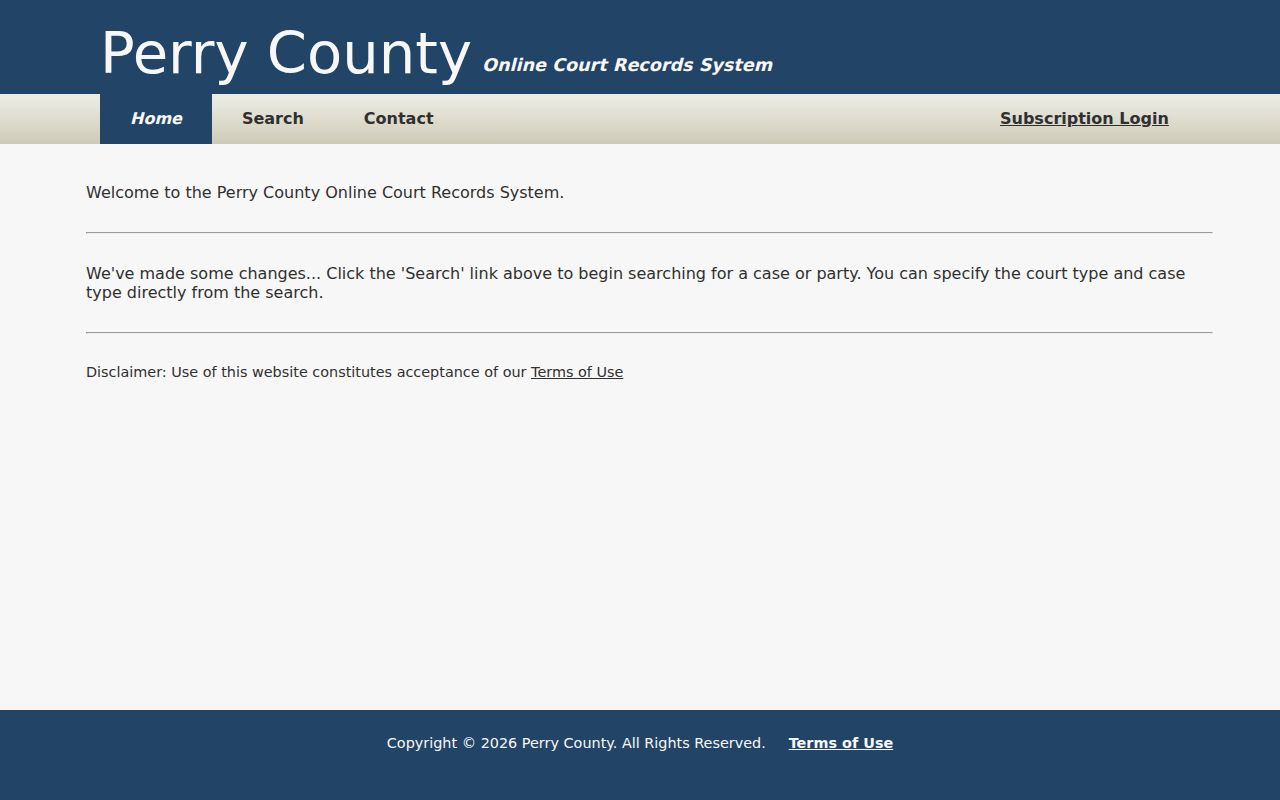
This is where Perry trial-court searching starts, not a statewide Tennessee index. It can point you toward a public case. Yet it cannot promise the entire file. Need a signed order, a pleading, an exhibit, or a certified copy? Note the case identifier. Ask the right clerk for that item.
Case Number Searches
Say the reference reads 99GS1-2023-CR-12345. Portal help says to type 12345 into Case Number. An older Case Reference goes in the Party Name / Case Reference box instead. Do not read hidden meaning into each code segment. The clerk has not assigned one. Case Year means the original filing year. That year can differ from the year of the latest hearing. Keep the two straight. The blank Perry County search form source shows these controls.
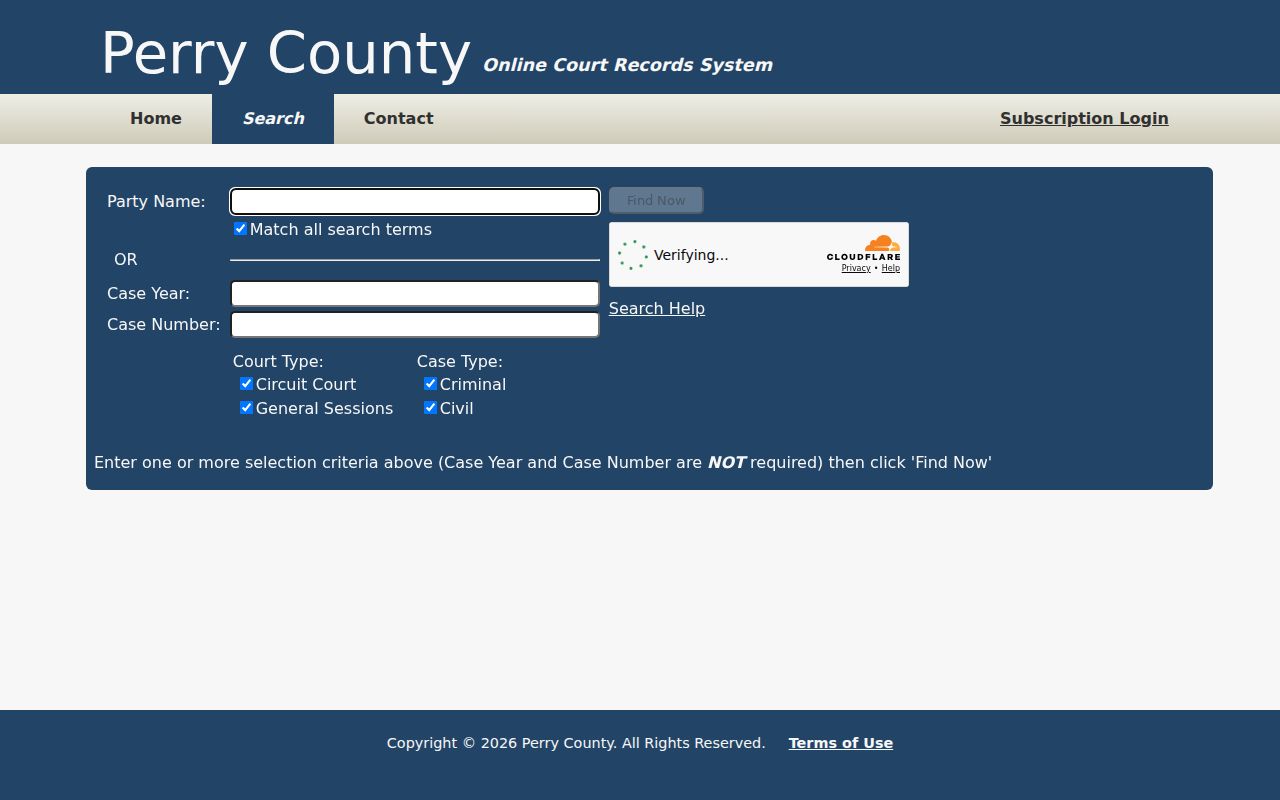
The form design is confirmed there, with no party record exposed. If a complete number fails, enter its final numeric segment just as the portal instructs. Still no luck? Call the clerk rather than guessing at another format.
Perry County Search Behavior
Portal help describes more than a plain exact-name search. Only the first ten words in the Party Name / Case Reference box count. Quotation marks trigger a phrase search. Text drops to lower case, and the system allows limited typo tolerance for longer terms. Those rules can widen or narrow a Perry County docket search in quiet ways. “Match all search terms” starts out checked. The help also says the system may trim terms from the end and add matches when too few rows exist to fill its result set. So a returned row is never proof of identity. Check the case style, court, year, and number yourself. The help sets a maximum of 2,500 rows and allows sorting through the result-column headers. A Filter box, if it appears after searching, works on visible text only and does not run a new court query.
Case Search Results Explained
A Perry County result shows a lot. Look for case number, court, case type, case style, party role, filing year, event date, status, next hearing, and document list. Treat that as a checklist of things to verify. It is not a promise that every field shows up on the public screen. Turnstile blocks access to live result rows. So make no assumptions about document images, download links, balances, charges, or the exact detail layout. Read any result as an index lead. Confirm the style names the case you meant. Check that the court listed matches the path you expected. A misdemeanor often stays in General Sessions. A felony can begin there and move on to Circuit Court. A civil matter may belong to Chancery or Probate instead. It may never show among the visible choices. When an outcome truly matters, get the docket entry or the signed order. Do not trust a short status label.
| Case Number | The identifier to confirm with the clerk. |
|---|---|
| Style / Parties | The caption; a name match alone is not identity proof. |
| Case Type | Criminal or civil within Circuit or General Sessions. |
| Filed Date | The original year differs from a later hearing year. |
| Status | Read the actual disposition and date, not an assumption. |
Perry County Clerk Search Routes
The Perry County public search form lets you pick Circuit Court or General Sessions. Each one splits into Criminal and Civil. When the form comes up empty, go straight to the source. Joy Breeding's office serves as both Circuit Court Clerk and General Sessions Clerk. Call 931-589-2218, stop by the courthouse at 121 E. Main Street in Linden, or mail your request to P.O. Box 16 after confirming the address. Give the clerk a name, a year, the likely court, and the docket entry or document you want. A quick phone call also tells you a lot. It can say whether an entry is too new to post, too old for the portal, or sitting only in the clerk's own file.
Chancery and Probate records travel a different road. The county Chancery page sends visitors into the broader Tennessee court-record family. But the Perry County form offers no Chancery or Probate checkboxes. Clerk and Master Charlene Dupressis handles that side at 931-589-2217. Divorce, guardianship, conservatorship, adoption, estate, real-estate, tax, and other equity filings may sit with her office. They may land there instead of the Circuit Clerk.
Juvenile cases run through the same clerk structure, yet they stay confidential. A missing juvenile record is not a glitch to work around. Linden and Lobelville municipal courts were folded into General Sessions. So a city label on a traffic or ordinance matter is one more reason to try the Perry County route.
Two Ways to Search: Perry County and State
Perry County dockets are searchable through the Tennessee Public Court Records System, which routes you to participating county systems, and Perry keeps its own county instance there. Appellate history lives in a separate state court tool instead.
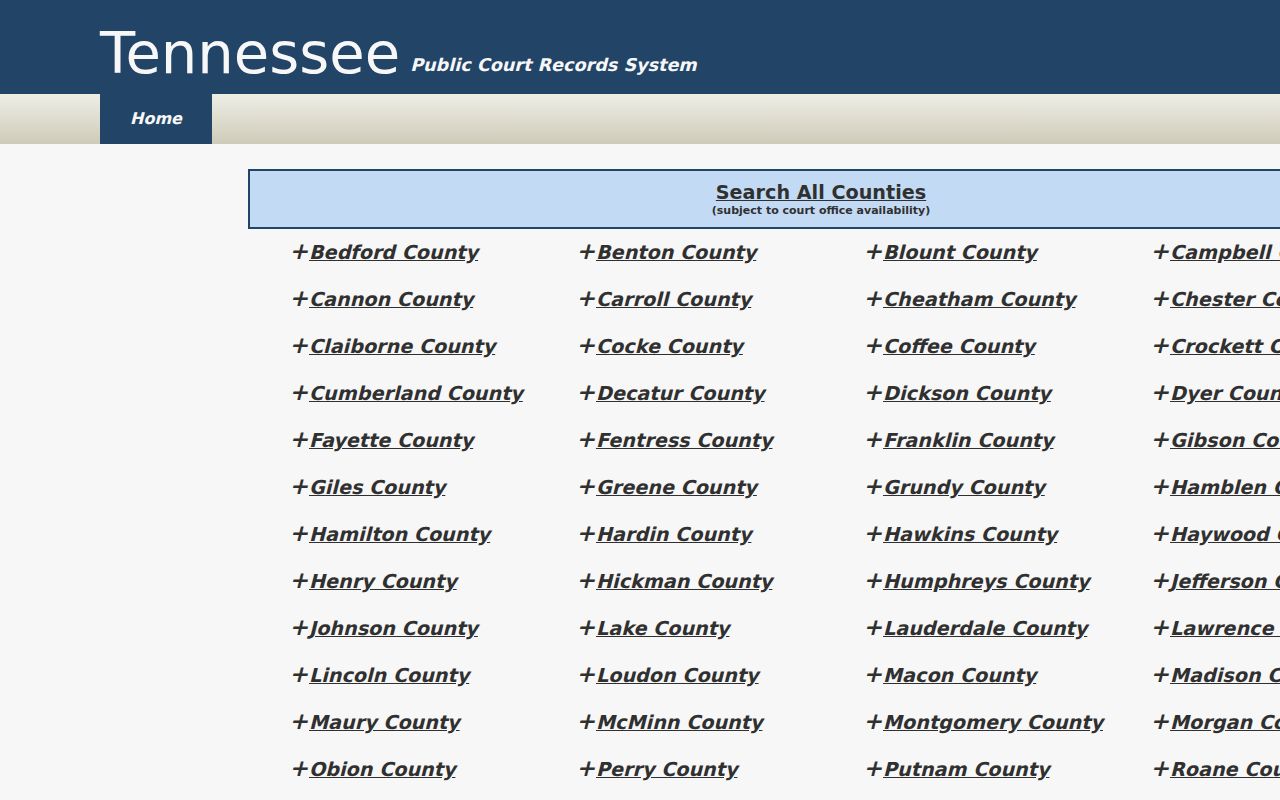
The selector illustrates why statewide branding does not mean one complete trial-court index.
| State court route | Perry County portal |
|---|---|
| Separate appellate history and county links | Perry Circuit and General Sessions |
| Not one universal trial index | Public form with known local filters |
| Best for an appeal or county route | Best for a known Perry trial case |
Perry County Appellate Search Split
When a Perry County trial case is appealed, it gains a whole separate search path. It often gets a new number too. The Tennessee appellate public case-history form lets you search by Case Number, Case Style, Party Name, or Business and Organization. It cannot replace the local trial docket. Civil appeals go to the Tennessee Court of Appeals. Criminal appeals go to the Tennessee Court of Criminal Appeals.
Coverage has limits that the state itself spells out. History generally begins after September 1, 2006, and documents after August 26, 2013, with the newest filings possibly lagging behind. Did the matter begin in Circuit or General Sessions? Start in the Perry County trial system. Turn to appellate history once you know an appeal exists. Compare the two numbers and courts carefully. Otherwise you may mistake the appellate entry for the local docket itself.
Federal cases are a different world. Civil, criminal, and bankruptcy filings belong to federal systems, not either Tennessee form. A Perry County connection does not pull a federal case into the county portal. Identify the court and its jurisdiction before you search anywhere.
Which Cases Stay Restricted
Not every Perry County record is open. Juvenile cases, sealed files, dependency matters, and other protected records may simply not appear. An expunged entry can carry restricted visibility too. Don't try to work around those limits. Tennessee Supreme Court Rule 34 starts from public access but keeps the exceptions that statute, rule, or court order create. Ask the clerk whether docket-level information or a redacted record can lawfully be released.
Use a name search to follow a specific court matter, not to draw big conclusions from a single index hit. Read the disposition and the date. A retired criminal matter is not automatically a final dismissal. A setting is not a judgment. If the file turns out to be sealed or confidential, follow the court's own access process.
When Perry County Search Fails
A blank result can mean several things. You may have picked the wrong court. You may have caught a filing too new to be indexed, referenced an older case, or hit a protected record. You may also have landed outside the portal's visible scope. Strip out unneeded terms and verify the original filing year. Try the numeric suffix. Also check both Circuit and General Sessions when the case path is unclear. For a court date, the official adult calendar is another source worth consulting.
If the portal stays down, switch to a clerk-supported request. Phone, counter, and confirmed mail channels all work. A sufficiently specific Tennessee Public Records Act request can help with an identifiable public record, though it will never open a sealed or juvenile file. When access is denied, ask for the legal basis. Then request any redacted public portion that may be released.
For fees, the official county clerk page points to CourtFeePay, whose landing page follows.

That payment portal is worth a note, because paying and searching are separate tasks. A receipt from CourtFeePay does not hand you the docket, the disposition, or the full court file.